

From Neural Signals to Patient Function: Why Neurotechnology Needs Systems, Not Just Science
The Translation Gap in Brain-Computer Interface Technology — Governance, Infrastructure, and the Path to Clinical Reality

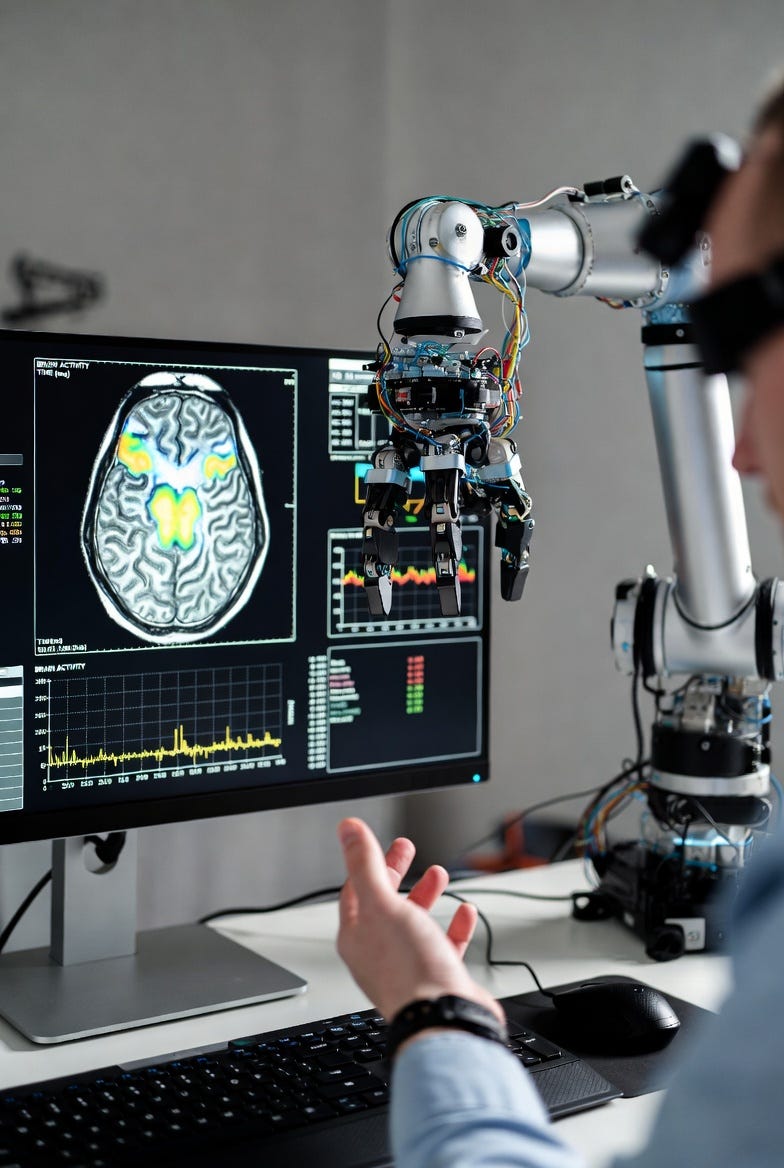
NeuroEdge Nexus — Edition 22 | March 2026
Neurotechnology is no longer limited by scientific discovery, but by the capacity of health systems to translate it into patient function.
A patient with cervical spinal cord injury sits in a rehabilitation unit. The science describing how to decode their motor cortex signals has been published. The engineering to translate those signals into robotic finger movements has been validated. A meta-analysis confirms clinical benefit exists. And yet the technology is not in the room. It never arrived. This is not a limitation of discovery. It is a structural constraint within current translational systems
— and it is the most important challenge in applied neurotechnology today.
Three studies published between 2024 and 2025 together describe, with unusual clarity, the full chain of what brain-computer interface (BCI) technology now makes possible. Read individually, each is a significant scientific contribution. Read together, they reveal something more uncomfortable: that the science is ready, the engineering is ready, the clinical evidence exists
— and patients are still not recovering hand function at scale.
The bottleneck is not in the laboratory. It is in the systems surrounding it.
Neural Precision Is Ready
A study published in Nature Communications in 2025 demonstrates real-time decoding of individual finger movements using a non-invasive brain-computer interface. The system reads motor imagery signals from the primary motor cortex — specifically from the somatotopic finger representation area — and translates them through a deep neural network into precise robotic hand control at the individuated finger level.
This is technically significant because earlier BCI systems could only decode gross motor intentions: open hand, close hand, move cursor. Real functional recovery after spinal cord injury or stroke requires something finer — the ability to distinguish between individual finger movements, to control grip, to manipulate objects.
The somatotopic hand area of the motor cortex is highly specialised. Decoding signals from this region in real time, non-invasively, at finger-level resolution, is precisely the neurophysiological capability that clinical translation has been waiting for.
The interpretation: the neural precision required for functional motor restoration now exists at the scientific level.
The Engineering-Clinical Interface Is Validated
A randomised controlled trial published in the Journal of NeuroEngineering and Rehabilitation evaluated BCI-controlled soft robotic glove therapy in patients with subacute stroke. Using functional near-infrared spectroscopy (fNIRS), the study confirmed not only that patients showed significant improvement in upper limb function, but identified the biological mechanism underlying that improvement: bilateral sensorimotor cortical reorganisation, with prefrontal cortex activation correlating directly with functional gains.
This is the essential next step in the translation chain. It is not enough to show that the engineering interface between neural signal and robotic actuation is technically feasible. It must also be shown to produce cortical plasticity — to drive real, measurable reorganisation of motor circuits in patients with neurological injury.
This study provides that confirmation. The biological basis for BCI-driven rehabilitation is no longer theoretical.
The interpretation: engineering translation of neural signals into clinical rehabilitation has been validated at the level of brain mechanism.
Clinical Evidence Exists — But the System Cannot Yet Scale It
A systematic review and meta-analysis, registered with PROSPERO, Journal of NeuroEngineering and Rehabilitation and published in 2025, evaluates the effects of non-invasive BCI on motor function, sensory function, and daily living abilities in patients with spinal cord injury. The pooled results are positive: BCI-based rehabilitation improves outcomes across these domains.
The authors also include an observation that must be read carefully. Of the nine studies included in the analysis, only one reported adequate allocation concealment and blinding. The remaining studies carried a high risk of selection and assessment bias. Long-term follow-up data were largely absent. The authors conclude that future stratified follow-up studies are urgently needed.
This is not a limitation of science. It is a precise description of infrastructure constraint: the clinical research system does not yet have the standardised trial protocols, validated outcome measures, long-term follow-up frameworks, and regulatory clarity required to produce evidence that can confidently scale.
The interpretation: clinical benefit has been demonstrated, but the evidence base is methodologically fragile because the infrastructure to produce robust long-term evidence has not been built.
The Gap Is No Longer Scientific. It Is Systemic.
Three consecutive layers of the BCI translation chain now have scientific or clinical evidence supporting them: neural signal decoding, engineering actuation, rehabilitation outcomes. Each layer works. And yet the chain does not deliver at scale.
The constraint is not scientific. It is not technological. Current health systems are not yet fully equipped to integrate these innovations at scale — and in most jurisdictions, most healthcare settings, and most research environments, all five layers are not yet fully operational simultaneously.
The Five Layers of Clinical Translation
For a neurotechnology such as a brain-computer interface to reach real patients, the following five layers must be operational and coordinated:
• Scientific discovery — understanding neural signals, motor cortex organisation, and the neurophysiology of injury and recovery
• Engineering development — translating biological signals into devices capable of actuating real movement in real patients
• Clinical validation — generating safety and efficacy evidence through adequately designed, long-term trials with standardised outcome measures
• Regulatory governance — creating clear approval pathways, safety standards, neural data oversight, and post-market surveillance frameworks
• Health system integration — building hospital infrastructure, clinical training, reimbursement pathways, and patient access frameworks
Neurotechnology does not fail in the laboratory. It fails between layers
— in the transition from scientific result to validated clinical endpoint, from validated endpoint to regulatory approval, from regulatory approval to health system integration.
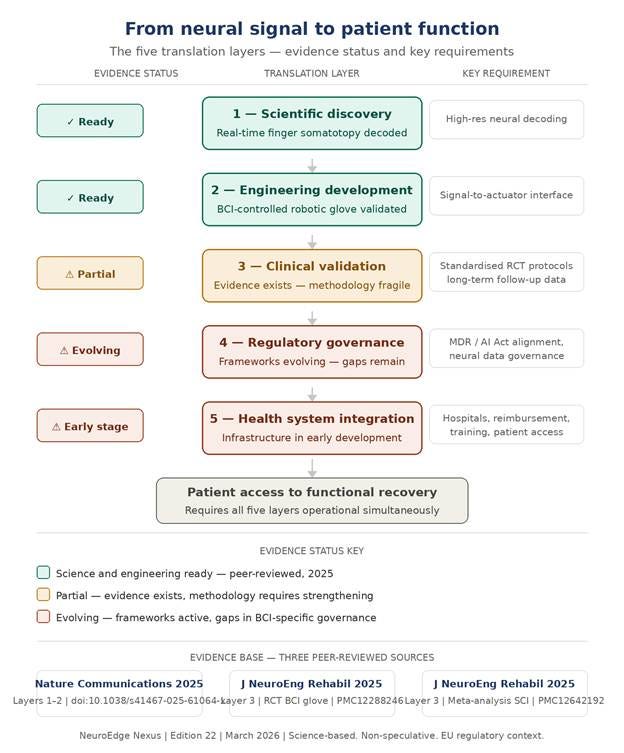
Figure: The Five Layers of Clinical Translation in Neurotechnology — Evidence Status and Key Requirements
This is the daily reality observed at the interface of neurological research and clinical practice. Patients present with conditions that science has been addressing for years. The publications exist. The mechanisms have been described. The trials have been conducted. The technology does not arrive because the system surrounding the technology has not been built.
Why Governance Is Not an Obstacle. It Is the Condition.
Brain-computer interfaces occupy a unique position in the regulatory landscape. They are not generic medical devices. They interact directly with the central nervous system. They generate neural data — among the most sensitive categories of personal biological information. They raise questions about patient autonomy during device use, data privacy across device lifetime, informed consent for implantation, and long-term responsibility for device maintenance, removal, and failure.
Standard medical device regulatory frameworks were not designed for this category. In the European Union, the Medical Device Regulation (MDR) defines the pathway for implantable neurotechnology, but the specific frameworks for neural data governance, AI-driven decoding systems, and long-term BCI safety monitoring remain areas of active regulatory development.
The European Health Data Space and the Artificial Intelligence Act together establish the foundations for responsible governance of AI-driven health technologies — including the kind of neural decoding systems described in the Nature Communications study. These are not bureaucratic obstacles. They are the conditions under which clinical BCI technology can scale responsibly and with the trust of patients and clinicians.
Europe has both the regulatory architecture and the scientific capacity to lead in clinical neurotechnology translation — but only if these frameworks are applied proactively, not reactively. Policy makers, regulatory bodies, and health system planners who invest now in BCI-specific governance infrastructure will determine whether European patients benefit from this technology in 2030 or 2040.
The institutions that build coherent governance infrastructure will determine who leads clinical neurotechnology. This is not a scientific competition. It is a systems competition.
Ethics as Infrastructure, Not Afterthought
Neurotechnology that interacts with the nervous system requires an ethical framework that is built into the translation process from the beginning — not added at the regulatory approval stage. This includes:
• Neural data privacy: standards for collection, storage, analysis, and deletion of data generated by implanted or non-invasive BCI devices
• Patient autonomy: frameworks ensuring that patients retain meaningful control over device use, modification, and removal
• Long-term safety responsibility: clear institutional accountability for monitoring device performance over years, not months
• Access and equity: governance structures that prevent BCI technology from becoming accessible only to well-resourced healthcare systems
Without this ethical infrastructure, clinical BCI technology cannot be trusted at scale — and without trust, it cannot reach patients at scale. Ethics is not a constraint on translation. It is a precondition for it.
A Signal Worth Noting
On 13 March 2026, China’s National Medical Products Administration (NMPA) granted commercial approval to the NEO brain-computer interface system, developed by Neuracle Medical Technology (Shanghai) — the first BCI device to receive commercial regulatory authorisation in any jurisdiction. The available clinical dataset covers 36 implant procedures; peer-reviewed publication of the full trial results has not yet appeared in international literature. This development should be interpreted as a signal of regulatory system alignment, not as definitive clinical evidence. The scientific and safety questions accompanying a first commercial implantable BCI remain open.
The relevant observation for governance and policy is not the speed of this approval. It is the demonstration that coordinated investment in all five translation layers — science, engineering, clinical evidence, regulatory pathway, and health system infrastructure — can produce a different outcome than investment in discovery alone.
The NeuroEdge Nexus Perspective
The future of neurotechnology will not be determined by which laboratory produces the most precise neural decoding algorithm. It will be determined by which systems can successfully integrate science, engineering, clinical validation, regulatory governance, and health system infrastructure — simultaneously and coherently.
This is not a peripheral concern for neuroscience. It is its central challenge. The three studies reviewed in this edition are not simply advances in BCI technology. They are a precise map of where the translation system is functional and where it is not. The science works. The engineering works. The clinical evidence is fragile because the research infrastructure is inadequate.
Progress in neurotechnology will not accelerate by producing more discoveries. It will accelerate when the systems surrounding discovery — regulatory frameworks, clinical research infrastructure, governance structures, health system capacity, and ethical oversight — are built with the same seriousness and investment as the science itself.
As examined in the previous edition of NeuroEdge Nexus, the bottleneck in translating biological signals into clinical practice is not the technology — it is the infrastructure surrounding it. Brain-computer interfaces make that bottleneck visible at its most acute
Scientific progress in neuroscience is accelerating. The ability to read the brain, decode intention, and actuate movement now exists. The question is no longer whether neurotechnology can work.
The question is whether our systems
— clinical, regulatory, ethical, and infrastructural
— are capable of carrying that science to the patients who need it.
That is where the future of neurotechnology will ultimately be decided. Not in the laboratory. In the systems that connect the laboratory to the patient.
References
1. Li Y et al. EEG-based brain-computer interface enables real-time robotic hand control at individual finger level. Nature Communications. 2025. doi:10.1038/s41467-025-61064-x
2. Zhang X et al. Effects and neural mechanisms of a brain-computer interface-based soft robotic glove on upper limb function in subacute stroke: a randomised controlled fNIRS study. Journal of NeuroEngineering and Rehabilitation. 2025. PMC12288246. doi:10.1186/s12984-025-01704-x
3. Wang L et al. The impact of non-invasive brain-computer interface technology on the therapeutic effect of patients with spinal cord injury: a meta-analysis. Journal of NeuroEngineering and Rehabilitation. 2025. PMC12642192. doi:10.1186/s12984-025-01766-x. PROSPERO: CRD420251026140.
4. Xu J et al. Home use of a fully implantable wireless brain-computer interface in a patient with tetraplegia: a longitudinal feasibility study. medRxiv preprint. 2024. doi:10.1101/2024.09.05.24313041 [Preprint — not yet peer-reviewed. Cited as regulatory signal only.]
NeuroEdge Nexus translates neuroscience, AI, and European regulatory frameworks into strategic analysis. Season 2 (2026) focuses on governance, infrastructure coordination, and implementation challenges in digital brain health.