

Sleep as an Early Biomarker of Alzheimer’s Disease
A Neurophysiological Perspective

DOMAIN
Neuroscience & Alzheimer’s Prevention
SERIES EVOLUTION
Editions 21 → 22 → 23: From signals to biomarkers
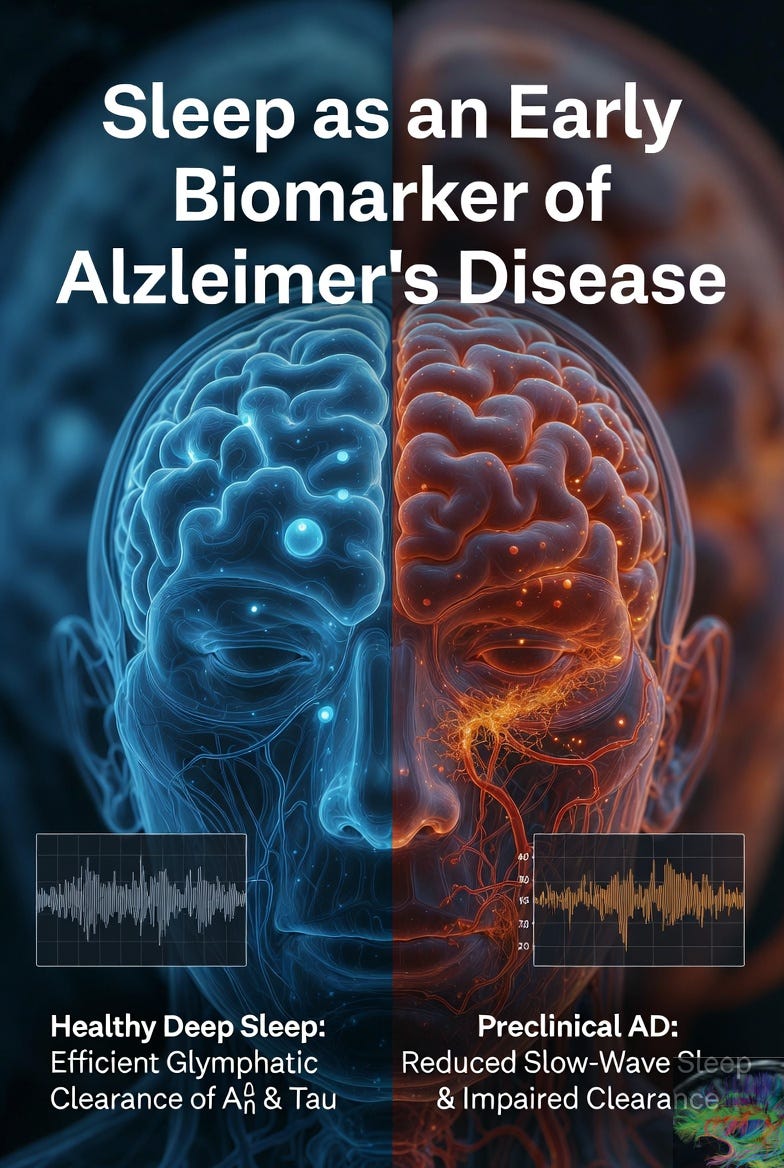
Alzheimer’s disease does not begin with memory loss and the signal that precedes it may already be present every night, in the physiological record of how we sleep.
CLINICAL VIGNETTE
A 64-year-old neurologist presents for routine evaluation. Cognitive testing is normal. MRI is unremarkable. Blood biomarkers are within expected range. She reports no cognitive concerns.
Yet an overnight polysomnography recorded three years earlier shows a 22% reduction in slow-wave activity and increased sleep fragmentation compared to age-matched controls.
She has no diagnosis. No symptoms.
But the signal was there — recorded, timestamped, and not clinically interpreted.
Where this fits in NeuroEdge Nexus Series
Edition 21 established the body as data — demonstrating how digital biomarkers and wearable systems enable continuous physiological monitoring.
Edition 22 identified the translational bottleneck as systemic: governance, infrastructure, and implementation — not scientific discovery.
Edition 23 applies this framework to Alzheimer’s disease, where sleep may represent one of the earliest accessible physiological signals of preclinical pathology.
Beyond Symptoms: Where Alzheimer’s Begins
By the time cognitive symptoms emerge, neurodegenerative processes have often been evolving for years — if not decades.
This preclinical phase represents the primary window for intervention, yet remains largely inaccessible in routine clinical workflows.
The question is no longer conceptual, but operational:
How do we detect Alzheimer’s disease before symptoms — at scale, and in a way that health systems can act on?
Sleep is increasingly emerging as a candidate answer.
Study 1 — Sleep EEG as a Brain Health Biomarker at Scale
A study published in NEJM AI (2026) analysed 36,000 polysomnography recordings from 27,000 individuals across six cohorts.
Using deep learning, the model derived a Brain Age Index (BAI) directly from raw EEG, without expert-defined features.
The BAI showed significant associations with:
cognitive performance
dementia risk
mortality
—including in individuals who were cognitively normal at baseline.
KEY FINDINGS (NEJM AI, 2026 | DOI: 10.1056/AIoa2500487)
36,000 PSG recordings across 6 cohorts
AI-derived BAI from raw EEG
Strong association with cognitive decline and dementia risk
Detectable signal in preclinical individuals
The interpretation is significant. The study does not claim that sleep EEG diagnoses Alzheimer’s disease. It demonstrates that an AI-derived index of brain health — extracted from a single overnight EEG recording — carries meaningful prognostic information about cognitive decline and dementia risk at population scale. This is precisely the kind of scalable, non-invasive signal that the translational framework established in Edition 22 requires.
The biomarker is not created by the AI model. It is revealed through it
— extracted from a physiological record that already exists.
Study 2 — Wearable Sleep Recording: From Hospital to Home
The second key study in this edition demonstrates that the precision of sleep-based Alzheimer’s detection does not require a hospital-grade polysomnography suite. Published in npj Aging (2025), this research evaluated whether multimodal wearable sleep recordings could achieve clinically meaningful accuracy for Alzheimer’s disease screening.
Participants:
67 cognitively normal
35 Alzheimer’s patients
Using single-channel EEG + accelerometry and AI-driven analysis:
KEY FINDINGS (npj Aging, 2025)
Detection accuracy: 0.90 (AD), 0.76 (prodromal AD)
Wearable signals matched hospital PSG performance
Physiological features outperformed sleep staging
This finding has direct translational relevance. It means the barrier to deployment is not technical — it is systemic. The signal is accessible from consumer-grade wearable devices. The analytical pipeline is available. This establishes that the signal is not confined to specialised laboratories.
It is accessible at the point of care — and potentially at population scale.
What We Are Actually Measuring During Sleep
Polysomnography captures a multi-system physiological state:
THE POLYSOMNOGRAPHY SIGNAL LANDSCAPE
EEG — neural oscillations (slow waves, spindles, REM dynamics)
ECG — autonomic regulation
Respiration — ventilatory control and oxygenation
EMG / movement — arousal and motor patterns
The signal is already available. What remains underdeveloped (as demonstrated by both studies in this edition) is the systematic interpretation of that signal in the context of neurodegenerative disease risk. The NEJM AI study shows what is possible at scale. The wearable study shows what is possible at the point of care. Together, they define the current frontier.
From Biomarker to Deployment Minimum Viable Pathway
Step 1 — Risk Stratification
Sleep EEG-derived indices integrated into at-risk populations (≥60, APOE4, subjective decline)Step 2 — Targeted Confirmation
High-risk profiles trigger plasma, CSF, or PET biomarkersStep 3 — Longitudinal Monitoring
Wearable sleep EEG enables continuous tracking over timeStep 4 — Intervention Layer (Current State)
Risk modification, sleep-targeted strategies, and trial inclusion
✅ Biomarker Strengths
• Non-invasive and repeatable
• Already recorded in clinical practice
• Detectable in preclinical individuals (NEJM AI)
• Accessible via wearable devices (npj Aging)
• Scalable to population-level screening
⚠️ Translation Barriers
• Not yet standardised for AD risk stratification
• No validated clinical intervention pathways
• Regulatory frameworks for AI-derived biomarkers evolving
• Reimbursement structures absent
• Long-term outcome data still limited
At present, no sleep-based biomarker meets regulatory criteria for standalone Alzheimer’s diagnosis or treatment initiation.
AI as an Enabling Layer — Not the Core
Both studies reviewed in this edition use artificial intelligence. In the NEJM AI study, deep learning extracts a brain health index from 36,000 recordings that no human expert could have derived manually. In the npj Aging study, AI-driven sleep staging enables wearable-grade recordings to match hospital-grade discriminative capacity.
In neither case does AI redefine the underlying physiology. The slow-wave activity is still there. The sleep fragmentation is still measurable. The amyloid-beta dynamics are still occurring. AI provides the analytical layer that makes these signals interpretable at scale — and that is precisely the role it should occupy.
AI does not create the biomarker. It reveals it — and makes it readable at a scale and resolution that changes what clinical practice can do.
Public Health and EU Policy Perspective
From a public health standpoint, the implications of these two studies are significant. Across Europe, Alzheimer’s disease represents a growing burden, with interventions still largely focused on symptomatic stages. The European Health Data Space (EHDS), established in March 2025, creates the regulatory architecture for health data sharing — including the kind of longitudinal sleep EEG data that this research depends on.
The AI Act establishes risk-based governance for AI systems used in healthcare — directly applicable to AI-derived biomarker tools like the BAI described in the NEJM AI study. As the European Brain Council has emphasised: without brain health, there is no health. The policy framework exists. The signal exists. The analytical tools exist. What is needed is coordinated deployment.
This is exactly the systems challenge that Edition 22 described — and which sleep-based Alzheimer’s biomarkers now make concrete: not a question of whether the science works, but whether the infrastructure surrounding it can be built with the same seriousness as the science itself.
System Responsibility — From Signal to Implementation
Health systems → integrate sleep biomarkers into prevention pathways
Regulators → define validation standards for AI-derived EEG biomarkers
Payers → establish reimbursement models
Industry → generate outcome data and standardise devices
The limiting factor is no longer signal detection
— it is coordinated system ownership.
The NeuroEdge Nexus Perspective
For decades, sleep has been recorded with high-resolution physiological tools.
The signal has been present.
What has been missing is:
structured interpretation
clinical integration
system-level deployment
The evidence is now sufficient to define sleep as a candidate biomarker for early Alzheimer’s detection.
The remaining challenge is not scientific.
It is organisational.
EDITION 23 — KEY SCIENTIFIC POSITIONS
• Alzheimer’s pathology precedes clinical symptoms by years — early signal detection is the clinical priority
• Sleep EEG carries a Brain Age Index detectable across 36,000 recordings — Ganglberger et al., NEJM AI 2026
• Wearable single-channel EEG achieves 90% AD detection accuracy at home — npj Aging, 2025
• Sleep is a candidate biomarker — non-invasive, repeatable, and already embedded in clinical systems
• AI reveals the signal — it does not create it. The physiology is the biomarker; AI is the analytical layer
• EHDS + AI Act provide the regulatory foundation — clinical deployment requires coordinated systems investment
Scientific References
1. Ganglberger W, Sun H, Turley N, Tripathi A, Hadar P, Gupta A, Gallagher K, et al. Brain Health from Sleep EEG: A Multicohort, Deep Learning Biomarker for Cognition, Disease, and Mortality. NEJM AI. Published February 26, 2026. 2026;3(3). doi:10.1056/AIoa2500487
2. Wearable sleep recording augmented by artificial intelligence for Alzheimer’s disease screening. npj Aging. 2025. [Wearable EEG + accelerometry; AI-driven sleep staging via SeqSleepNet; n=102 (67 controls, 35 AD). Peer-reviewed publication. Full DOI pending confirmation — cited for methodological findings only.]
3. Lucey BP et al. Reduced non-rapid eye movement sleep is associated with tau pathology in early Alzheimer’s disease. Science Translational Medicine. 2019;11:eaau6550.
4. Winer JR et al. Sleep as a potential biomarker of tau and β-amyloid burden in the human brain. Journal of Neuroscience. 2019;39:6315–6324.
5. Mander BA et al. Sleep: a novel mechanistic pathway, biomarker, and treatment target in the pathology of Alzheimer’s disease. Trends in Neurosciences. 2016;39:552–566.
6. European Health Data Space (EHDS). Regulation (EU) 2025/327 of the European Parliament and of the Council. Entered into force March 2025.
NeuroEdge Nexus translates neuroscience, AI, and European regulatory frameworks into decision-grade strategic analysis. Season 2 (2026) focuses on governance, infrastructure coordination, and the implementation gap in digital brain health.